Church of San Salvario
The 1646 church on Via Nizza, right by Porta Nuova station, gave the district its name. Founded by Christine of France and run by the Servites.

City district
San Salvario begins right behind Porta Nuova station: 19th-century buildings, a Moorish-style synagogue, a neo-Gothic Waldensian church and streets packed for aperitivo in the evening. By the Po, the Parco del Valentino awaits with its castle and medieval village.
from€39.00per person
Book the e-bike tour with San Salvario
San Salvario lies south-east of the old town and begins right at Porta Nuova station. Turismo Torino calls it "the district next to Porta Nuova station" and one of the most popular districts among young people in Turin. To the north it is bordered by Corso Vittorio Emanuele II, to the east by the Po and the Parco del Valentino, and to the west by the railway tracks.
Administratively, San Salvario belongs to Circoscrizione 8, together with Borgo Po, Cavoretto, Nizza Millefonti, Lingotto and Filadelfia.
The streets form a grid of 19th-century apartment buildings with shops, cafés and small eateries on the ground floor. The main axes are Via Nizza along the station, Via Madama Cristina in the middle and Corso Massimo d’Azeglio by the park. In between lies Largo Saluzzo, the small square that a lot of the evening revolves around.
To get to Piazza Castello and the sights of the city centre, walk along Via Roma. That makes San Salvario a good way to round off a day in the city: museums in the centre during the day, the Valentino Park in the afternoon, and aperitivo in the district in the evening.
The district takes its name from the church of San Salvario on Via Nizza, right next to the station. Christine of France, widow of Duke Vittorio Amedeo I, founded it in 1646 and handed it over to the Servite order. At the time the church still lay far outside the city, on the road to her summer residence, the Castello del Valentino.
The area was only built up in the 19th century, when Turin grew beyond its old boundaries and Porta Nuova station was built. Two religious communities that until then had had hardly any rights also moved into this new urban expansion area. With the edict of 17 February 1848, King Carlo Alberto recognised the civil rights of the Waldensians; the Jews were granted equal rights in March 1848.
The church, the Waldensian church, the synagogue and the mosque are only a few streets apart. Not least because of this, San Salvario is considered Turin's multicultural district.
These are places of worship, not museums. Please respect services and ask before taking photos inside.
The 1646 church on Via Nizza, right by Porta Nuova station, gave the district its name. Founded by Christine of France and run by the Servites.
Neo-Gothic Waldensian church from 1853 at Corso Vittorio Emanuele II 23, by the architect Luigi Formento. It was built five years after the Waldensians were granted equal rights in 1848.
The Tempio Israelitico at Piazzetta Primo Levi 12 was completed in 1884 in an eclectic, Moorish-influenced style. Visits only by prior booking via torinoebraica.it.
The prayer hall of the Associazione Culturale Islamica di San Salvario at Via Saluzzo 18 – not a sightseeing destination, but part of what makes the district what it is.
By day San Salvario is a quiet residential district. From early evening the streets fill up. Turismo Torino describes the district as the place for restaurants, trattorias and clubs – it's mainly young people from Turin who come here.
Most of the bars are close together. According to the City of Turin's noise management plan, the hotspots are Largo Saluzzo and Via Saluzzo, Via Belfiore, Via Berthollet, Via Sant’Anselmo and Via Baretti. At weekends people stand out in the street there until late at night.
The typical thing is aperitivo in the early evening: a drink, often a vermouth from Turin, with small bites. If it turns into dinner, it's called "apericena". Find out more about how aperitivo works in Turin on our page about aperitivo in Turin. How Turin's vermouth came about is explained separately.
We deliberately don't recommend individual bars: in San Salvario, venues open and close all the time. The best thing is to start walking from Largo Saluzzo and see what you like.
Other nightlife areas are the Po riverside from the Valentino to Piazza Vittorio Veneto and the Quadrilatero Romano in the old town.
San Salvario is an ordinary residential and nightlife district. Lots of people are out in the evening, especially at weekends. The usual big-city rules apply:
If you're looking for a quiet night, be aware that around Largo Saluzzo it can be loud until late at weekends.
On the eastern edge of San Salvario, the Parco del Valentino stretches along the Po. Turismo Torino calls it the city's oldest and best-known park. It was laid out as a public park in the mid-19th century by the landscape architect Barillet-Deschamps.
Entry is free. At the entrance stands the Arco monumentale all’Artigliere, a triumphal arch by Pietro Canonica from 1930. There are playgrounds, bike hire and refreshment kiosks.
The park has three sights worth noting:
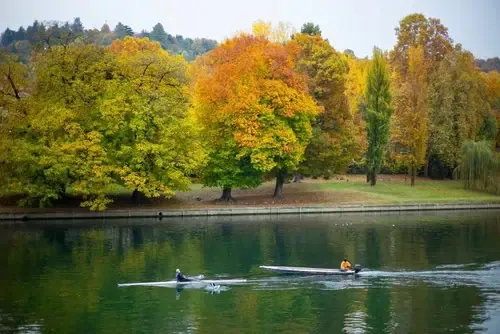
The park is at its best on a sunny afternoon: a stroll along the riverbank, rowers on the Po and a view across to the hills. If you'd rather cycle, you'll find two bike tours below that go through the park.
Since 1997 the castle on the Po has been part of the UNESCO World Heritage Site "Residences of the Royal House of Savoy". Emanuele Filiberto acquired the estate in 1564. It got its current form under Christine of France, the "Madama Reale", who had Carlo di Castellamonte remodel it in the French taste. Since 1906 it has been home to the Politecnico di Torino; today it houses the faculty of architecture.
Visiting: because people study and work in the castle, it is not freely accessible. The Politecnico offers free guided tours, for which you have to register online at castellodelvalentino.polito.it. They run on Saturday mornings during certain periods – in 2026, in summer and in September. The tours are in Italian and last around an hour. They show the rooms of the piano nobile, the hall of columns and the chapel.
Places are limited and go quickly. Check before your trip whether dates are currently on offer. You can see the façade from the park at any time.

The Borgo Medievale is not a real medieval village. It was built for the Esposizione Generale Italiana of 1884 under the direction of Alfredo d’Andrade. The houses, shops and the castle (Rocca) are replicas of 15th-century buildings and interiors from Piedmont and the Aosta Valley.
Important for your planning: the Borgo and the Rocca have been closed for restoration since 1 January 2024. Turismo Torino gives 2027 as the end of the works. The official website borgomedievaletorino.it states "chiuso al pubblico" without a date. In 2026 the City of Turin also launched a procedure to find a new operator.
There are therefore currently no opening hours or admission prices. As soon as the Borgo reopens, we'll add them here.
The address is Viale Virgilio 107, at the southern end of the park by the Po.

As of 1 October 2026, according to the official websites and Turismo Torino.
| Place | Open | Official admission |
|---|---|---|
| Parco del Valentino | freely accessible | free |
| Castello del Valentino | only on Politecnico guided tours, with online registration | free |
| Borgo e Rocca Medievale | closed (restoration since 1 January 2024) | – |
| Orto Botanico, 1 October to 15 November 2026 | Sat 14:30–18:00, Sun and public holidays 10:00–18:00 | €7.00, reduced €5.00 |
| Orto Botanico, 16 November 2026 to 26 March 2027 | closed to individual visitors | – |
Orto Botanico: entrance at Viale Mattioli 25, last admission 30 minutes before closing, no reservation needed. Reduced tickets apply to children aged 6 to 12 and visitors aged 65 and over, among others; under-6s go free. With the Torino + Piemonte Card you pay €5.00. Current times: ortobotanico.unito.it.
An afternoon walk that can flow into aperitivo. It starts at Porta Nuova station and ends at the Valentino Park by the Po.
From Porta Nuova station, walk into Via Nizza. Just behind the station stands the 1646 church of San Salvario, which gave the district its name.
Heading back north, you reach the neo-Gothic Waldensian church from 1853 at Corso Vittorio Emanuele II 23.
A few streets further into the district stands the Moorish-style synagogue from 1884. You can see it from outside at any time; to visit the inside you need to book.
Along Via Saluzzo, past the Moschea Omar, you come to Largo Saluzzo, the small square at the heart of the district. Make a note of the surrounding streets for the evening.
Heading towards the Po, you come to Corso Massimo d’Azeglio and enter the Parco del Valentino. Look out for Pietro Canonica's Arco monumentale all’Artigliere, which marks one of the park entrances.
In the park you reach the Castello del Valentino at Viale Mattioli 39. Right next to it is the Botanical Garden – open at weekends until 15 November 2026.
Follow the riverbank south to the Borgo Medievale. It may be closed, but the riverside walk is still worth it.
To finish, head back into the district around Largo Saluzzo. If you're tired, take the metro from Dante or Nizza on Via Nizza.
We haven't found a dedicated guided tour of San Salvario alone from the big providers. According to the providers, these two bike tours go through the district or the park respectively and combine them with the highlights of the city centre.
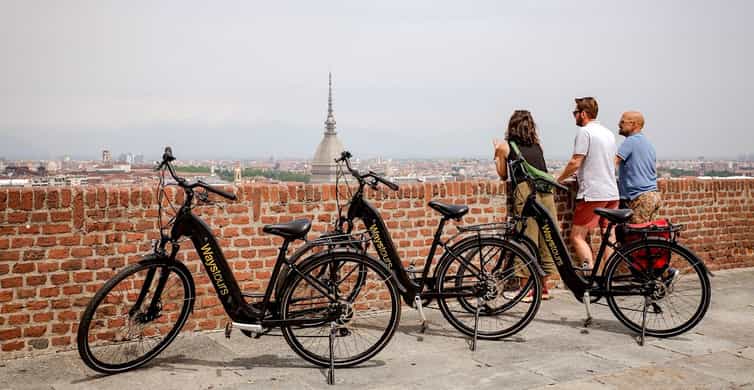
A three-hour small-group e-bike tour (max. 8 people): Piazza San Carlo, Palazzo Reale, the Mole, the Monte dei Cappuccini viewpoint, the Valentino Park and the San Salvario district. Language: English. Minimum age 14 and minimum height 155 cm.
from €39.00
Details & booking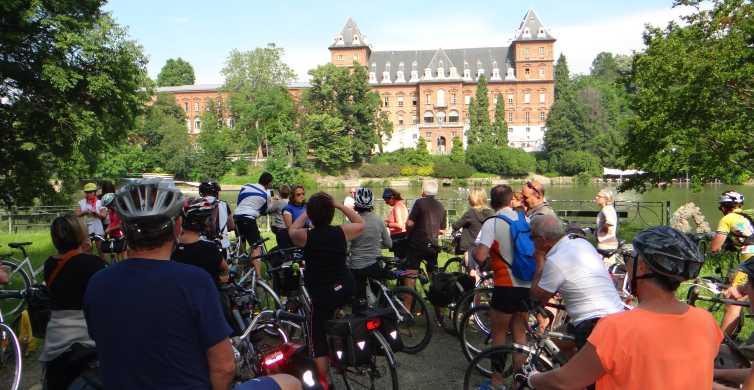
A three-hour bike tour to the royal residences, through the Parco del Valentino with the Giardino Roccioso, and to Palazzo Carignano. Bike and helmet included. Languages: English, Italian, German, French, Spanish.
from €30.00
Details & bookingAccording to the providers, both tours can be cancelled free of charge up to 24 hours in advance. More walks can be found under our city tours in Turin. According to the operator, the red line of the Hop-on Hop-off bus also passes the Valentino Park.
All tickets, fares and tips for buses, trams and the metro are on our page about public transport in Turin.
You don't need a pass for San Salvario itself: the park, the Castello tours and the places of worship are free. With the Torino + Piemonte Card you pay the reduced admission of €5.00 at the Botanical Garden. The Castello del Valentino is one of the Royal Pass residences, but it's free anyway. Both cards really pay off for the museums and palaces in the city centre and the surrounding area – our Torino Card vs Royal Pass comparison shows which suits you better.
South-east of the old town, between Porta Nuova station, Corso Vittorio Emanuele II and the Po with the Parco del Valentino. The district belongs to Circoscrizione 8.
From the church of San Salvario on Via Nizza, founded by Christine of France in 1646. The district around it was only built in the 19th century.
No. The Borgo and Rocca Medievale have been closed for restoration since 1 January 2024. Turismo Torino gives 2027 as the end of the works; there is no official reopening date (as of October 2026).
Only on free guided tours run by the Politecnico di Torino, for which you have to register online at castellodelvalentino.polito.it. They take place on Saturday mornings during certain periods – in 2026, in summer and in September – and are in Italian.
No, the park is freely accessible. Only the Botanical Garden charges admission: €7.00, reduced €5.00.
Around Largo Saluzzo and in the neighbouring streets, such as Via Saluzzo, Via Belfiore, Via Berthollet, Via Sant’Anselmo and Via Baretti. That's where lots of aperitivo bars are close together.
The district is very lively in the evening. The usual big-city rules apply: keep valuables safely stowed, stick to busy streets and don't cross the dark Valentino Park alone at night.
Yes, but only after booking with the Jewish community via torinoebraica.it. You can see the building on Piazzetta Primo Levi from outside at any time.
Porta Nuova for the north of the district, Marconi or Nizza for Largo Saluzzo and the middle of the district, and Nizza or Dante for the Castello and the Valentino Park.