Skip to content

Legends & folklore

Magic Turin: the legends of white and black magic

Few cities have as many stories about magic, alchemy and hidden symbols as Turin. Here you'll find out which legends surround Piazza Statuto, the Gran Madre and the Portone del Diavolo – and how much of it is historically documented.

  • Piazza Statuto as the “black heart”, Piazza Castello as the “white soul”
  • The Gran Madre and the Holy Grail, Portone del Diavolo, Toret
  • Clearly separated: legend here, documented facts there
  • Self-guided walk and tours with a guide

from€55.00per person

See the Torino Magica tour
Rated 4.6 out of 54.6
1,678 reviews
Book via GetYourGuide
Turin at night with the illuminated Mole Antonelliana above the rooftops
Foto: Stefano Parisi / Pexels

Why Turin is known as a city of magic

Turin has a reputation as the most “magical” city in Italy. Even the official tourist board, Turismo Torino, has a page dedicated to the subject. One thing first: everything you read in this section is legend and folklore. There is no historical evidence of magical powers – but there is plenty about the places the stories revolve around.

The two triangles: According to legend, Turin lies at the tip of two magic triangles. With Prague and Lyon it forms the triangle of white magic, with London and San Francisco the triangle of black magic. That would make Turin the only city belonging to both.

Two rivers, two souls: The city lies where the Po and the Dora meet. In the esoteric reading, the Po stands for the sun and the Dora for the moon. Even Roman Augusta Taurinorum is said to have been divided into an eastern part, where the sun rises, and a western part, where it sets. From this the legend derives the city's two poles: the “black heart” in the west at Piazza Statuto and the “white soul” in the east at Piazza Castello.

Founding myths: It is also said that an Egyptian prince founded the city, and that Phaethon, son of the sun god, crashed with the sun chariot into the Eridanus – the ancient name of the Po. On top of that comes the claim that the 45th parallel symbolically divides the city.

The places themselves are real and easy to reach on foot. On this page you'll find the documented facts for each legend, a walk from the black to the white heart and the matching guided city tours.

The legends at a glance

What people say – and what can actually be said about each place.

PlaceLegendDocumented fact
Piazza Statuto“Black heart”, gateway to the underworldSquare from the 1860s, Fréjus monument from 1879
Piazza Castello“White soul”, alchemical grottoesCentre of the Savoy residences with Palazzo Reale and Palazzo Madama
Gran Madre di DioHiding place of the Holy GrailChurch marking the king's return, consecrated in 1831
Portone del DiavoloDevil's door that appeared overnightBaroque portal of Palazzo Trucchi di Levaldigi, Via XX Settembre 40
Museo EgizioMagical place, underground grottoesEgyptian Museum, founded in 1824
ToretLucky charm, symbol of the cityGreen drinking fountains with a bull's head, introduced in the late 19th century
Nostradamus inscriptionThe seer lived in TurinInscription dated 1556 handed down, no longer surviving today

Piazza Statuto: the “black heart”

Piazza Statuto lies at the western end of Via Garibaldi, the pedestrian street just under a kilometre long that links it with Piazza Castello. The square was built in the 1860s, financed by an English company – it is one of the last squares Turin laid out in the 19th century.

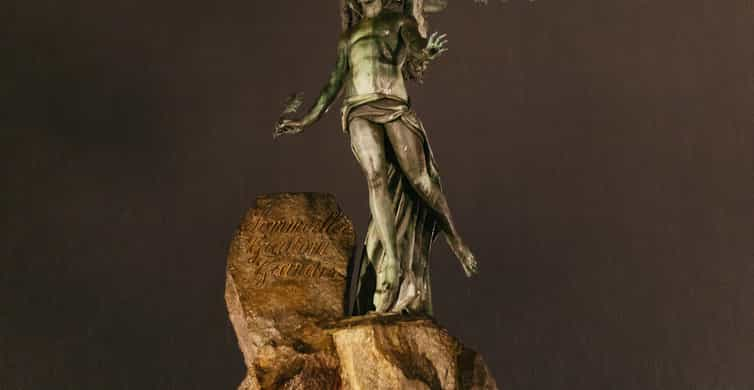
The Fréjus monument: In the middle, since 1879, stands the monument to the railway tunnel through the Fréjus, completed in 1871. Defeated titans lie on a pyramid of massive boulders, and at the very top stands a winged genius with a five-pointed star on his head. It was meant as an allegory: reason and science conquering the brute force of the mountain.

What the legend makes of it: In popular belief the genius becomes Lucifer, and the monument is seen as a gateway to the underworld. The reasoning comes from the history of the place: in the west, where the sun sets, the Romans are said to have buried their dead and executed convicts. The name of the Valdocco district is also often traced back to “valle occisorum”, the “valley of the slain” – there is no evidence for this. In the 19th century, however, there really was a place of execution not far away, the “Rondò della Forca”.

The small obelisk on the square is interpreted in the legends as the tip of the black triangle. Its real purpose is more down-to-earth: it marks a geodetic point, the end of a baseline the mathematician Giovanni Battista Beccaria used in the 18th century to measure an arc of the meridian.

Piazza Statuto is also where the Torino Magica tour starts – at sunset, according to the provider.

Fréjus monument with the winged genius on Piazza Statuto in Turin
Foto: Luca Mazza / Pexels

Piazza Castello: the “white soul”

At the other end of Via Garibaldi lies the counterpart: Piazza Castello, the centre of the residences of the House of Savoy, with Palazzo Reale and Palazzo Madama. According to legend, this is where the city's “white”, positive soul beats.

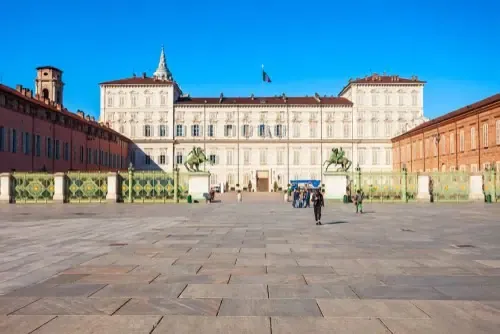
  • The railings with the Dioscuri: In front of Palazzo Reale, bronze railings designed by Pelagio Palagi separate the main courtyard from the square. On them stand the equestrian statues of the Dioscuri, Castor and Pollux. They play a part in esoteric readings: on their heads they wear five-pointed stars – just like the genius on Piazza Statuto.
  • The grotte alchemiche: Beneath the centre there are said to be three alchemical grottoes where scholars searched for the philosopher's stone. Depending on who is telling the story, they lie under the Egyptian Museum or under an old pharmacy. Nobody has ever found them – they are pure legend.
  • The Shroud: Behind Palazzo Reale stands the cathedral. The Shroud of Turin was kept from 1694 to 1993 in Guarino Guarini's Chapel of the Holy Shroud (Cappella della Sindone) and has been kept in the cathedral since then. For many storytellers it is the strongest pole of the “white” side. Today you visit the chapel with the Musei Reali.

According to the provider, the Torino Magica tour also shows the symbols on the cathedral's façade. You can read more about the cathedral and the district behind it on our page about the Quadrilatero Romano.

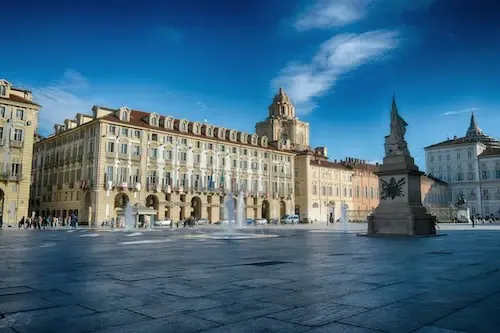
Piazza Castello in Turin in the evening with Palazzo Reale and the dome of San Lorenzo
Foto: Matteo Tocci / Pexels

Gran Madre di Dio and the Holy Grail

The best-known legend of magic Turin is set across the Po. The church of Gran Madre di Dio was built in thanks for the return of King Victor Emmanuel I after the end of French rule. The architect Ferdinando Bonsignore modelled it on the Pantheon in Rome, and it was consecrated in 1831. Italy's official tourism portal calls it “the most esoteric church in Turin”.

The legend: Somewhere between the two statues on the front steps, Fede (Faith) and Religione (Religion), the Holy Grail is said to be hidden. Fede holds a chalice – her gaze or the chalice itself is taken as a clue to the hiding place. There is no evidence for this.

Visiting: The Gran Madre stands at Piazza Gran Madre di Dio 4 and, according to Turismo Torino, is open Monday to Saturday from 8:00 to 19:00; different hours apply on Sundays. Tram 13 terminates right in front of the church. On foot, you get there from Piazza Vittorio Veneto across the Ponte Vittorio Emanuele I bridge. Everything about the church, the bridge and the Monte dei Cappuccini viewpoint is on our page about Borgo Po and the Gran Madre.

Church of Gran Madre di Dio in Turin in the evening
© Bar Vardi / Shutterstock.com

Portone del Diavolo: the Devil's Door on Via XX Settembre

At Via XX Settembre 40 stands Palazzo Trucchi di Levaldigi, built at the end of the 17th century for the Counts Trucchi di Levaldigi. Its entrance is known as the “Portone del Diavolo”, the Devil's Door. The Baroque portal has four columns decorated with flowers, fruit, animals and putti. In the middle hangs a bronze door knocker: a devil's head with horns and an open mouth, entwined by snakes.

The legends:

  • A sorcerer's apprentice is said to have summoned the Devil. He made the door appear overnight and locked the apprentice inside the palace for ever.
  • The city's first tarot card workshop is said to have operated on the ground floor in the 17th century. According to tradition, the old house number 15 matches the Devil card in the tarot.
  • There is also the story of a dancer who is said to have been stabbed by an invisible hand here in the 18th century, in front of an audience. There is no evidence of the incident.

Today the palace houses a bank branch. You can see the portal from the street at any time – it is also on the route of the Torino Magica tour.

Toret: the green bull fountains

The Toret aren't places of black or white magic, but they are part of any walk through Turin. These green drinking fountains with a bull's head are spread all over the city. According to the Italian National Tourist Board ENIT, they were installed at the end of the 19th century to provide free drinking water for residents and visitors. Some have a second spout at the bottom so that animals can drink too.

The bull is Turin's heraldic animal. Various figures circulate about how many Toret there are today; we have not found an official count.

Another bull, another custom: On Piazza San Carlo a bronze bull is set into the pavement. An old custom invites you to step on it – this is supposed to ensure that you return to Turin.

The Egyptian Museum as a “magical” place

Turismo Torino also counts the Egyptian Museum among the city's esoteric places. That fits the founding legend of the Egyptian prince and the stories of alchemical grottoes beneath the museum.

What is documented: the Museo Egizio was founded in 1824 and is at Via Accademia delle Scienze 6. Among the pieces with the strongest presence are numerous statues of the lion-headed goddess Sekhmet, goddess of destruction and healing. They come from Karnak and reached Turin with the Drovetti collection.

Allow about two hours for your visit. Admission is free with the Torino + Piemonte Card and reduced with the Royal Pass. Opening hours, prices and guided tours are on our Egyptian Museum page.

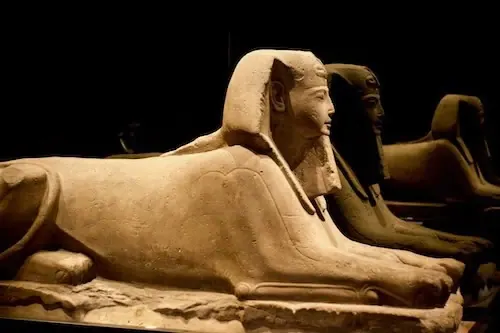
Sphinxes in the Egyptian Museum in Turin

More places from the legends

These places keep cropping up in the stories of magic Turin.

Nostradamus inscription

An inscription dated 1556 has been handed down. In essence it said that Nostradamus had lived here, where Paradise, Hell and Purgatory are – and that whoever honours “victory” gains glory, while whoever scorns it is ruined. The house no longer stands and the plaque is lost. Whether the seer ever came to Turin is not reliably documented.

Fontana Angelica

The fountain on Piazza Solferino is by the sculptor Giovanni Riva and shows four figures representing the seasons. Esoteric readings see Masonic symbols in it and a “gateway to knowledge” between the male figures.

Mole Antonelliana

The city's landmark is also on Turismo Torino's list of esoteric places. Today it houses the National Cinema Museum, and a panoramic lift takes you to the top.

See the Mole Antonelliana

Tunnels under the city
Photos: GetYourGuide

Tunnels under the city

Entirely real: countermine tunnels from the siege of 1706. The Museo Pietro Micca at Via Guicciardini 7/A shows around 400 metres of them, 6 to 14 metres below the street.

from €55.00

Details & booking

Sacra di San Michele

Turismo Torino counts the abbey on Monte Pirchiriano in the Susa Valley among the magical places of the province. It inspired Umberto Eco's “The Name of the Rose”.

See the day trip ideas

Museo della Sindone

In the crypt of the church of SS. Sudario, Via San Domenico 28, everything revolves around research into the Shroud. Open daily from 15:00 to 18:00, standard ticket €8.00, free with the Torino + Piemonte Card.

Walk: from the black to the white heart

The main places from the legends are so close together that you can walk between them in an afternoon. The route is most atmospheric towards evening. You'll pass Toret on many street corners along the way.

  1. Piazza Statuto

    Start at the Fréjus monument with the winged genius, the “black heart”. Take a look at the small obelisk too.

  2. Piazza Solferino

    Continue to the Fontana Angelica with its four figures of the seasons.

  3. Portone del Diavolo

    At Via XX Settembre 40 the door knocker with the devil's head awaits.

  4. Piazza San Carlo

    Look for the bronze bull in the pavement and follow the custom. The Egyptian Museum on Via Accademia delle Scienze is just nearby.

  5. Piazza Castello and the cathedral

    The “white soul”: the Dioscuri on the railings of Palazzo Reale, and behind them the cathedral with the Shroud.

  6. Gran Madre di Dio

    Finish along Via Po, across Piazza Vittorio Veneto and over the bridge to the Gran Madre – with a view of the statue of Fede and her chalice. Alternatively, tram 13 takes you to the front of the church.

Tours of magic and dark Turin

With a guide you learn more details than fit on any sign – and some tours take you to places that are otherwise closed.

Torino Magica® – the original

Torino Magica® – the original

4.6 · 1,678 reviews

⏱ 2 hours – 2.5 hours🗣 English, Italian, French, German, Japanese, Spanish

This esoteric tour tells the story of Turin's “two souls”. According to the provider, it starts at sunset on Piazza Statuto, the “heart of darkness”, and leads to the façade of the cathedral, the Portone del Diavolo and Masonic symbols around the city. Duration according to the provider: two to two and a half hours.

Languages according to the provider: Italian, English, German, French, Spanish, Japanese – group tours in Italian and English, the other languages as private tours.

from €55.00

See Torino Magica
Underground Turin

Underground Turin

4.7 · 662 reviews

⏱ 2.5 hours – 3 hours🗣 English, Italian, German, Spanish, French, Japanese

18th-century tunnels and Second World War air-raid shelters. According to the provider, the meeting point is in front of the Museo Pietro Micca, and entrance tickets are included. Minimum age 6, not suitable for people with reduced mobility.

Languages according to the provider: Italian, English, German, Spanish, French, Japanese.

from €55.00

See the tunnel tour
Turin Noir: evening walk

Turin Noir: evening walk

4.7 · 213 reviews

⏱ 2.5 hours🗣 Italian

Stories of witchcraft and historical crimes, plus exclusive openings: the old church of the Misericordia and a climb up a bell tower with a view over Turin by night. According to the provider, the meeting point is in front of the cathedral, Via XX Settembre 87.

Language according to the provider: Italian only.

from €32.00

See Turin Noir
Sacra di San Michele

Sacra di San Michele

4.7 · 112 reviews

⏱ 4 hours – 5 hours🗣 English, Italian, French, German, Russian, Japanese and others

Half-day trip to the abbey in the Susa Valley with coach, guide and admission. According to the provider, it departs from Piazza Solferino in front of the Teatro Alfieri – right next to the Fontana Angelica.

from €60.00

See the trip

For all four tours the product page states: free cancellation up to 24 hours in advance. Prices, duration and ratings live from GetYourGuide.

Into the museums of the legends with the Torino Card

The guided tours aren't included in any card. But the Torino + Piemonte Card gets you free admission to many places from the legends: the Egyptian Museum, the Musei Reali with the Chapel of the Holy Shroud, Palazzo Madama, the Museo della Sindone and the National Cinema Museum in the Mole Antonelliana.

More about the Torino Card
Torino + Piemonte Card

Royal Pass: the palaces around Piazza Castello

After the “white soul”, would you like to see the Savoy residences from the inside too? The Royal Pass covers the Musei Reali and Palazzo Madama, plus palaces such as Venaria and Stupinigi. At the Egyptian Museum the Royal Pass only gives you a reduction, not free admission.

See the Royal Pass
Palazzo Reale on Piazza Castello in Turin

Discover more of Turin

Gran Madre di Dio from above

Borgo Po & Gran Madre

The Gran Madre, Monte dei Cappuccini and Villa della Regina on the other side of the Po.

See Borgo Po

Magic Turin: frequently asked questions

Back to top