Dome and lantern
The star of 16 ribs with the octagon of the lantern. Best seen by looking straight up from the middle of the church.

Free entry
From the outside you barely notice a church. Inside, one of the boldest domes of the Baroque opens up above you: a star of intersecting ribs, 55 metres high, built by Guarino Guarini. Here you will find out how to visit San Lorenzo, what to look out for and what links the church to the Shroud.
from€39.00per person
City walk including San Lorenzo
The Real Chiesa di San Lorenzo was the court church of the Dukes of Savoy. It stands on the corner of Piazza Castello and Via Palazzo di Città, just a few steps from the Royal Palace (Palazzo Reale) and Palazzo Madama. Many visitors walk straight past it, because the building has no church façade facing the street.
Step inside and you are standing in one of the most important buildings of the Italian Baroque. The architect Guarino Guarini, himself a Theatine priest, designed a centrally planned church with a tall drum and a dome that breaks with everything you know from Rome or Florence.
On 10 August 1557, Duke Emanuele Filiberto of Savoy defeated the French army at San Quintino, today's Saint-Quentin in Picardy. It was the feast day of Saint Lawrence. Emanuele Filiberto and Philip II of Spain therefore vowed to build a church for the saint.
In 1563, Emanuele Filiberto moved his capital to Turin. At first he fulfilled the vow only provisionally: an older, medieval church in the district of the government palaces was dedicated to San Lorenzo. This is where the Shroud found its first home in Turin in 1578, when it was brought from Chambéry – to make the pilgrimage easier for Charles Borromeo.
A new building was a long time coming. Vittorio Amedeo I entrusted the church to the Theatine order, and on 6 June 1634 the foundation stone was laid to a design by Carlo di Castellamonte. Yet in 1650 there was still only a provisional church under the arcades of the square. In 1664, another attempt began to plans by Amedeo di Castellamonte.
The breakthrough came with Guarino Guarini, who arrived in Turin in 1666. From 1670, the foundations were laid to his design. On 27 October 1679, the cross was placed on the lantern of the finished dome, and on 12 May 1680 Guarini himself celebrated the first Mass. Altars, stucco, statues and the floor followed until 1696.
Later work still shapes the church today: a restoration from 1823 to 1828, the painting of the dome and chapels from 1829, the repair of the 1943 bomb damage in 1956/57, and restorations for the Shroud exhibitions of 1998 and 2000. In 2022/23, the high altar and presbytery were restored.
Stand in the middle of the church and look up. Instead of a closed hemisphere, you see a web of arches. Eight pairs of arches, 16 ribs in all, cross each other to form an eight-pointed star. At its centre sits the regular octagon of the lantern. The church's official description calls the shape an "upturned basket".
Between the ribs, windows open in the vault segments. Light therefore comes in from many sides, and the structure looks light and almost floating. From the floor to the top of the dome, it is 55 metres.
Guarini was not only an architect but also a mathematician. He developed the dome from ideas about conic sections and solid geometry. At the same time, the building was meant to draw the eye upwards, towards the light – calculation and faith in a single image.
Tip: the dome is at its most impressive when daylight streams through the windows. So come in the morning or early afternoon rather than just before closing on a dull winter's day.
San Lorenzo has no church façade. Guarini did design one, but it was never built. Facing Piazza Castello, the building blends into the row of houses, with only the dome and lantern rising above it. From the square, you therefore mainly see the dome, not the church.
In front of the actual church lies the Oratory of the Addolorata, almost like an entrance hall. It was given its present form in 1846. The contrast between the unassuming exterior and the tall, bright domed space is part of the experience.
The address is Via Palazzo di Città 4, on the corner of Piazza Castello. Look out for the dome above the roofline: it shows you where to go.

Besides the dome, a walk round the chapels is worth it. The church describes each of them on its website.
The star of 16 ribs with the octagon of the lantern. Best seen by looking straight up from the middle of the church.
Created from 1680, consecrated in 1696. In 2022/23, the high altar and presbytery were restored.
Side chapels including those of the Immaculate Conception, the Nativity, the Annunciation, the Crucified Christ and Saint Cajetan. Stucco and statues were finished by 1696; the choir stalls date from 1730.
In the antesacristy hangs a copy of the Shroud, together with the negatives by the photographer Secondo Pia. Access to the room is limited.
San Lorenzo is closely linked to the Shroud of Turin. When the House of Savoy brought the cloth from Chambéry to Turin in 1578, it found its first home in what was then the provisional church of San Lorenzo.
Today you do not see the original here, but a copy. It hangs in the antesacristy, together with the negatives by Secondo Pia, whose photographs of the cloth became famous. Volunteers explain the copy at the posted times. The room is not always open – ask at the entrance.
Many of the church's volunteers came together during the public exhibitions of the Shroud between 1998 and 2015. The church was restored for the 1998 and 2000 exhibitions.
The original is now kept in the cathedral, a few minutes' walk away. It is only shown at special exhibitions. If you want to learn more about research into the cloth, visit the Museo della Sindone in the Quadrilatero Romano.
The two buildings are often confused, because both are by Guarini and they are only a few steps apart.
If you are interested in Guarini's architecture, combine the two: first San Lorenzo with free entry, then the Musei Reali with the Chapel of the Holy Shroud. That way you see two completely different domes by the same architect in one morning.
San Lorenzo is a working church. No sightseeing is possible during services. These are the times for visitors:
| Day | Visiting | Holy Mass |
|---|---|---|
| Monday to Saturday | 9:00–12:00 and 15:30–18:00 | 8:00 and 18:30 |
| Sundays and public holidays | 15:30–18:00 (no visits in the morning) | 9:30, 11:00, 12:00 and 18:30 |
Free entry. According to the official website, the church is open on weekdays 7:30–12:00 and 15:30–19:00; outside visiting hours it is reserved for prayer. As of October 2026, current times: sanlorenzo.torino.it.
Tours on site: volunteers explain the church during visiting hours, free of charge and in Italian. Some speak other languages, but this is not guaranteed. According to Turismo Torino, booking is no longer required.
Pietre Vive: once a month this group offers a free tour of the church, focusing on art and faith. Dates are posted on their social media channels (Instagram: pietrevive_torino).
Rules: groups are limited to 15 people. Dress appropriately. Selfies are not allowed; keep quiet during prayer and Mass.
Easy to combine: San Lorenzo is right in the middle of Turin's sights. Next door are the Musei Reali and Palazzo Madama, and a few minutes further on the cathedral and the Quadrilatero Romano. Our route Turin in one day shows you how to see the centre in a day.
San Lorenzo is on Piazza Castello, the central square of the old town. The entrance is at Via Palazzo di Città 4, on the corner of Piazza Castello.
You do not need a ticket for San Lorenzo itself. If you want to experience the church in the context of Piazza Castello and the Savoy palaces, these tours are a good fit:
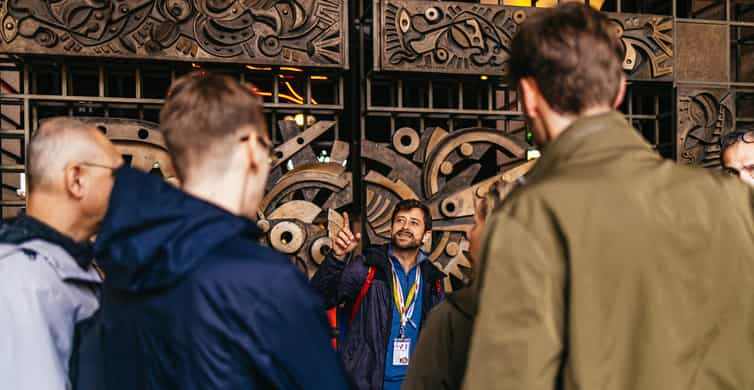
Small-group walk across Piazza San Carlo and Piazza Carignano to Piazza Castello with the Royal Palace, Palazzo Madama and the church of San Lorenzo; it ends at the Mole Antonelliana. Languages according to the provider: English, Italian. Meeting point: Piazza C.L.N., by the fountain.
from €39.00
Details & booking
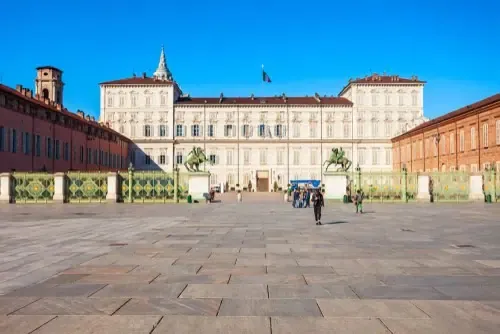
Guided tour of the Royal Palace with admission, followed by a walk through the centre, which according to the provider also includes San Lorenzo. Around 3 hours, languages: English, Italian. Meeting point: Piazzetta Reale 1.
from €79.90
Details & booking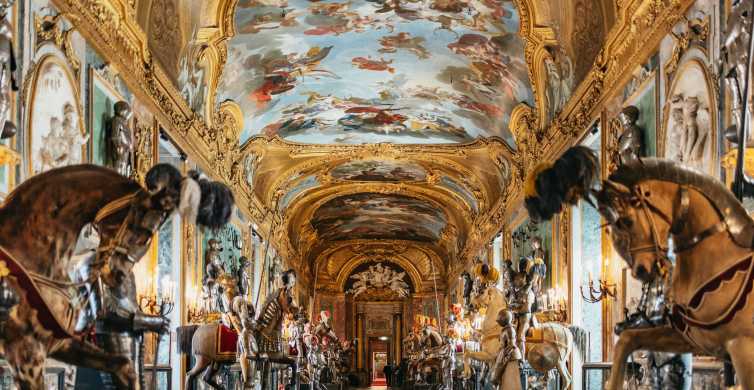
Two-hour guided tour with admission through the royal apartments and the Armoury (Armeria Reale), right next to San Lorenzo. Languages: German, English, French, Italian, Spanish.
from €59.00
Details & bookingAccording to the providers, all three tours can be cancelled free of charge up to 24 hours in advance. The providers do not say whether the inside of the church is visited – you can visit the interior yourself for free at any time during opening hours.
San Lorenzo is free to enter, so you do not need a card for it. For its neighbours, though, the card pays off: with the Torino + Piemonte Card you can visit the Musei Reali with the Chapel of the Holy Shroud, Palazzo Madama and the Museo della Sindone without paying further admission.
San Lorenzo was the court church of the House of Savoy. You can visit their palaces with the Royal Pass: it is valid for 96 hours at 16 residences, including the Musei Reali and Palazzo Madama on Piazza Castello.
No, entry to the Real Chiesa di San Lorenzo is free. The volunteers' explanations are free of charge too.
Monday to Saturday 9:00–12:00 and 15:30–18:00, Sundays and public holidays 15:30–18:00. No sightseeing is possible during Mass.
The Theatine priest and architect Guarino Guarini. He came to Turin in 1666, construction to his design began in 1670, and on 12 May 1680 he celebrated the first Mass.
It consists of eight pairs of intersecting arches, i.e. 16 ribs, forming an eight-pointed star with the octagonal lantern at its centre. Light falls in through windows between the ribs. It is 55 metres to the top.
Guarini did design a façade, but it was never built. The church blends into the row of buildings on Piazza Castello; from outside you mainly see the dome.
It goes back to a vow: on 10 August 1557, the feast of Saint Lawrence, Duke Emanuele Filiberto defeated the French at San Quintino. A church was then promised to the saint.
No, only a copy in the antesacristy, together with the negatives by Secondo Pia. The original is kept in the cathedral and only shown at special exhibitions. In 1578, however, the Shroud really was first kept in what was then the church of San Lorenzo.
No. Both are by Guarini, but the Chapel of the Holy Shroud belongs to the Musei Reali and can only be visited with their ticket. San Lorenzo is a church in its own right with free entry.
The volunteers on site explain in Italian; other languages are not guaranteed. The big providers have no dedicated tour of San Lorenzo; the highlights walk on this page passes the church in English or Italian.
You do not need it, because entry is free. The Torino + Piemonte Card pays off for the museums next door, such as the Musei Reali and Palazzo Madama.